

AUDITION TIPS
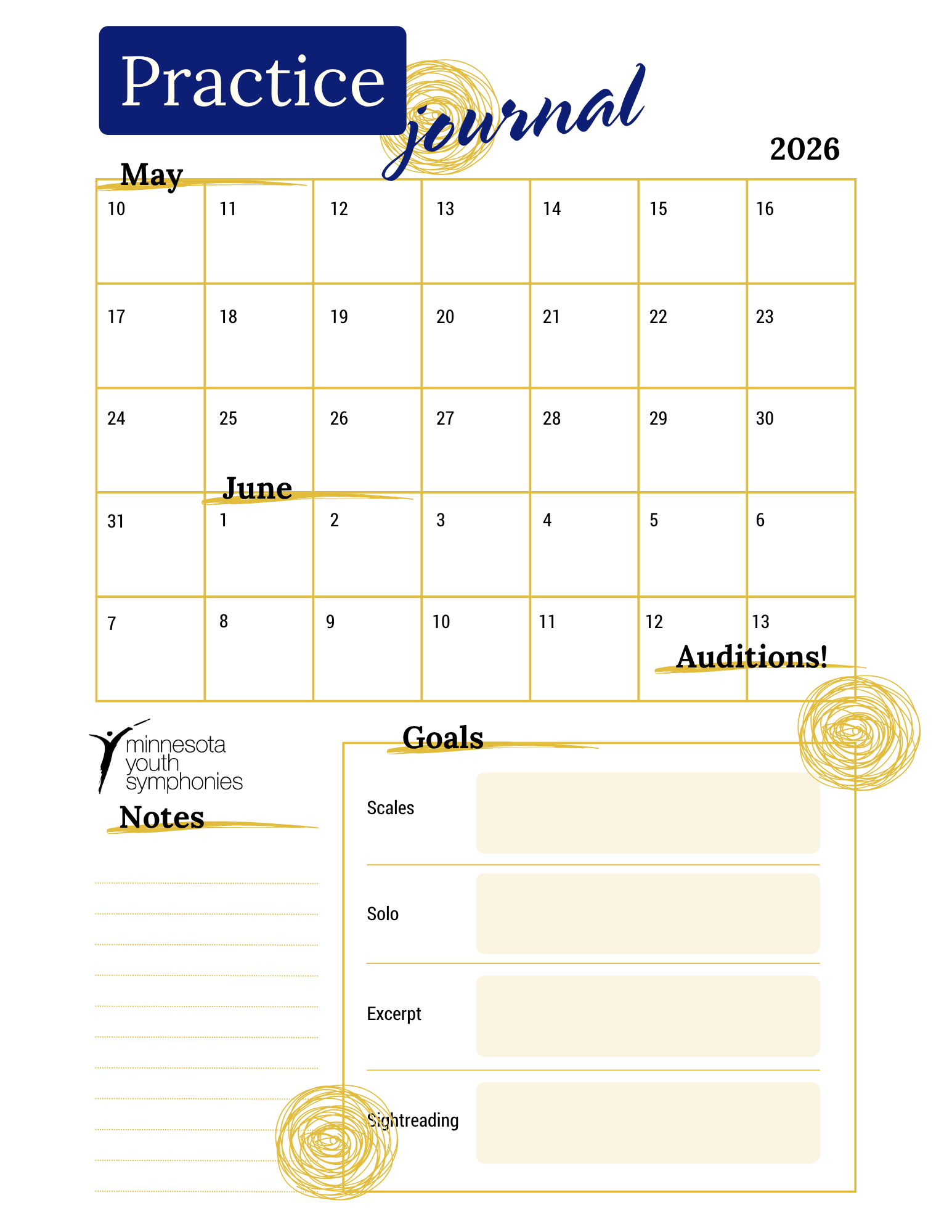
Practicing for Auditions
Ask your private teacher or school director to help you prepare.
Aim to memorize your scales, even if memorization is not required.
Select a solo piece that showcases your strengths, including range, technique, expression, dynamics, and style.
Listen to recordings of an orchestra playing the entire piece your excerpt is taken from.
Practice sight-reading using a method book exercise you’ve never played before. Learn from your mistakes, and consider recording yourself for additional feedback.
Practice frequently with a tuner and metronome to improve pitch and rhythm.
Give as much attention to expressive passages as technical ones, and try to convey a mood and feeling.
Know your audition material well enough so you can keep going even if something unexpected happens.
Record your audition material and listen back to assess your strengths and weaknesses. Lean into your strengths while increasing practice time in the weak areas.
Play your audition material for friends and family and ask them to provide comments.
Audition Day
We recommend dressing nicely but comfortably.
Remember to bring all of your music (hard copies of the excerpts will be available).
Please arrive 20-30 minutes before your scheduled audition time so that you can check in and warm up.
When you arrive for your audition, you will be informed which scales from the list you will be asked to perform.
Expect that your audition will last about 10-15 minutes.
Get involved in the music. The audition committee wants to hear the joy and expression of the music as much as they want to hear accuracy.
Keep going even if you make mistakes—don’t quit and don’t panic.
In the interest of time, adjudicators may ask you to play a particular portion or stop before the end.
Know that if the audition committee asks you to play something with a change it doesn’t mean you played it wrong. They may want to see how you take guidance and make a correction.
Enjoy yourself!
Practice perspective. After an audition, it’s easy to obsess and overanalyze your playing. But keep in mind that no audition/performance is ever perfect—it is a learning experience. Take away from it what worked and what can be improved on for next time.
Frequently Asked Questions
Should I audition for more than one orchestra to make sure I’m placed?
No—select just one orchestra to audition for. Choose the level that feels like the best match for your current playing by reviewing the audition packet for your instrument. The conductor who hears your audition will place you in the orchestra where you’ll be most successful, based on both your audition performance and the needs of the ensemble.
Should I choose an easier solo or a more difficult one?
The most important thing is that your solo is extremely well-prepared and performance-ready. It shouldn’t be at the extreme upper limit of your ability—only choose a very challenging piece if you can make it sound effortless. It’s better to play something less technical that you can perform confidently and expressively than something overly difficult.
How many scales will I have to play in the audition?
You should prepare all scales listed in the audition packet. In the audition, you’ll be asked to play two or three of them, and we’ll tell you know which ones when you check in for your audition.
What if I’ll be out of town on the main audition dates?
No problem—we offer multiple alternate audition dates. You should register and select the “I’m not available” option and Melissa will follow up with options based on your schedule.